

Most homeowners searching for garage door parts near me are already dealing with something that has gone wrong. A spring has broken, a cable is fraying, or a roller has cracked. The instinct to find the part and replace it quickly makes sense. What does not always make sense is how that part gets chosen. In our experience, the wrong part installed on the right door causes more damage than the original failure, and it almost always traces back to one root problem: a part was sourced by size or appearance rather than by specification.
Why the Quality of Garage Door Parts Near You Matters More Than You Think
We have arrived at jobs where a prior company replaced a torsion spring with one wound in the wrong direction for that side of the door, or with a wire diameter undersized for the door’s actual weight. In one situation, a homeowner had a complete spring and cable replacement done by another provider but the door still felt heavy, moved unevenly, and caused the opener to strain audibly on every cycle. When we inspected the system, the springs installed were rated for a lighter door. The physical dimensions were close enough to pass a casual look, but the mechanical specification was wrong, placing ongoing stress on the opener motor, lift cables, and door panels with every cycle.
Parts that are wrong for a system do not just perform poorly. They accelerate failure across everything they touch.
What to Know Before Searching for Garage Door Parts Near Me
Garage door systems are specification-dependent. A part that fits physically does not mean it is rated correctly for that door’s weight, travel height, or cycle demand. Before sourcing any replacement component, you need to know the door’s weight, the current spring specifications, the cable drum diameter, and the opener’s rated lifting capacity. Without those numbers, you are choosing parts by appearance, which is how systems end up in worse shape after a repair than before it.
Understanding Spring Types and Cycle Ratings
Torsion springs mount horizontally above the door on a steel shaft and twist to generate the lifting force that counterbalances the door’s weight. Extension springs run along the horizontal tracks on each side and stretch under load. Both types are engineered to a specific cycle rating governed by DASMA, the Door and Access Systems Manufacturers Association. A standard residential torsion spring is typically rated for around 10,000 cycles. High-cycle versions, which use a heavier wire diameter and tighter coil winding, are rated for 20,000 cycles or more and are worth the additional cost in homes where the garage is the primary entry point.
Choosing the correct spring goes beyond selecting the right length. Wire diameter, inside diameter, and winding direction, left-wound for the right side of the door and right-wound for the left, must all be matched precisely to the door’s weight and drum configuration. We have seen springs correct in length and coil count but wound in the wrong direction, causing the cable to unspool from the drum instead of winding onto it during closing. The door moves, but the system is destroying itself with every cycle.
Why Springs and Cables Are Not DIY Parts
Springs and cables operate under significant mechanical tension. A fully wound torsion spring stores enough energy to cause serious injury if it releases unexpectedly, and that risk does not diminish because the spring appears to be at rest. Selecting and installing these components requires winding bars, a torque calculation matched to the door’s weight, and the experience to verify the system is balanced correctly after installation.
We back our spring replacements with an 8-year warranty because every spring we install is matched to the door’s exact specifications and set to the correct tension before we leave. That warranty reflects what happens when the right part is installed at the right specification by someone who knows how to verify the result. If springs or cables are on your parts list, that portion of the job requires a professional.
Rollers: Why Material Grade Matters
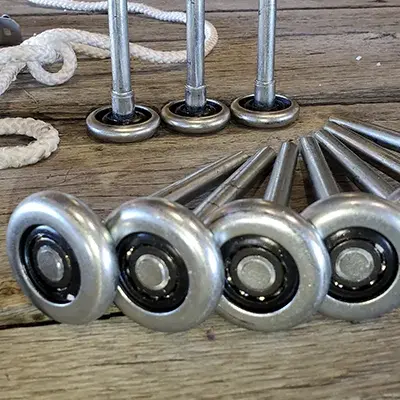
Rollers are one of the components where the difference between a quality part and a cheap substitute shows up fastest. Standard steel rollers produce significantly more noise, wear against the track surface, and require frequent lubrication to prevent seizing. Nylon rollers with sealed ball bearings run quieter, cause less track wear, and hold up better through Minnesota’s freeze-thaw cycles without the same lubrication schedule.
Quality varies within the nylon category as well. The ball bearing count determines how smoothly the roller turns under load. A low-bearing-count roller flexes slightly under the door’s weight, transferring lateral stress to the track and hinge mounting points over time. Quality nylon rollers use a minimum of 10 sealed ball bearings and are rated for the weight class of the specific door. Roller stem length and shaft diameter must also match the existing hinge configuration, or the door will not travel correctly through the track regardless of roller quality.
Cables: Matching Diameter and Length to Your System
Lift cables connect the bottom bracket of the door to the cable drum above and transfer the spring’s stored energy into controlled door movement. Cable diameter must match the drum groove width and the load rating of the spring system. An undersized cable stretches under repeated load cycles, slipping in the drum groove and fraying at the bottom bracket attachment point. We replace cables regularly that fail not because they were worn out but because they were the wrong diameter for the drum.
Aircraft-grade galvanized steel cable resists corrosion significantly better than standard wire rope, which matters in Minnesota where road salt and humidity reach garage interiors through seasonal use. The cost difference is minimal compared to the lifespan advantage, especially on doors cycling multiple times daily.
Openers and Smart Components: Stick With Manufacturer-Specified Parts
Opener components including drive gears, trolleys, drive belts, and logic boards are model-specific and should only be replaced with manufacturer-specified parts. We install and service LiftMaster openers, and the consistency we see from that brand comes from using components engineered for each model. Third-party logic boards and drive components often appear to fit physically but create compatibility issues with the safety sensor circuit, auto-reverse calibration, and smart home connectivity features.
Diagnosis should come before the parts order. What presents as a motor issue is sometimes a logic board fault, a sensor wiring problem, or a stripped drive gear caused by an overloaded spring system. Replacing the wrong component wastes money and leaves the actual cause untreated.
Weather Seals and Weatherstripping: Where Homeowners Have More Flexibility
Weatherstripping and bottom seals are among the few garage door components where homeowners have more flexibility in sourcing. Quality still varies in ways that matter here, particularly in Minnesota. A seal made from low-grade rubber or vinyl stiffens significantly in freezing temperatures, losing its ability to conform to the floor and allowing cold air, moisture, and pests to enter. It also drags against the door surface during operation, adding resistance to every cycle and accelerating wear on the bottom panel corners.
Look for a bottom seal made from EPDM rubber, which maintains flexibility well below freezing, and confirm the profile width matches your existing retainer channel before ordering. A seal that is slightly too wide will buckle and tear within a season.
Hardware: Hinges, Brackets, and What Cheap Parts Cost You
Hinges and end brackets are load-bearing components, not commodity items. Each hinge is rated by number, with a number one hinge used at the first joint from the bottom and higher numbers used progressively toward the top. Using the wrong hinge number at a given joint means the hinge is either over or underbuilt for the flex that section experiences during travel.
Thin-gauge hinges flex under load and transfer that energy into the door panel at the mounting points, causing the panel skin to crack and mounting holes to elongate over time. Heavy-gauge galvanized hardware holds its geometry through years of daily cycling and resists corrosion better in Minnesota’s freeze-thaw climate.
How a Professional Assessment Protects You From the Wrong Parts
A professional technician does not just identify what part failed. They identify why it failed, what specification is correct for the replacement, and whether adjacent components have been stressed by the failure. At MN Garage Door Service, every visit includes a 40-point inspection that gives us a complete picture of the system before any part recommendation is made.
This protects you from replacing the wrong part, watching it fail again, and paying twice. It also protects the parts we install, because a correctly specified component installed into a compromised system will not perform as designed. When everything is right, the system performs the way it was built to, and that is the standard we hold every job to before we leave.
Schedule Your Garage Door Parts Consultation With MN Garage Door Service
Knowing what quality garage door parts near you actually look like is the first step toward a system that performs reliably and safely. The second step is making sure those parts are matched correctly to your specific door before anything is installed. MN Garage Door Service provides expert parts assessment, specification matching, and professional installation across the Twin Cities metro and surrounding communities. Whether you are dealing with a failed spring, worn rollers, or a struggling opener, our team brings the field experience and technical knowledge to get it right the first time. Schedule your service with MN Garage Door Service today.